
Table of Contents
ToggleOverview of the Issue
Baxi and Main boilers are incredibly popular and reliable choices for heating homes. However, like all heating systems, they can occasionally experience issues that require your attention. When a fault occurs, the boiler will display an error code to help diagnose the problem. Three of the most common high-search error codes for Baxi and Main boilers are E50, E133, and E119. Understanding what these codes mean can save you time and money, and in some cases, you might be able to resolve the issue yourself without needing to call an engineer. In other situations, knowing the code will help you explain the problem clearly to a response boiler engineer.Common Fault Codes: E119, E133, and E50
E119: Low Water Pressure
The E119 error code is arguably the most common fault on Baxi and Main boilers. It indicates that the water pressure in your central heating system has dropped below the minimum required level, which is typically 0.5 bar. The boiler will lock out to prevent damage from operating dry.- How to check the pressure:
-
- Locate the pressure gauge: Look at the pressure gauge on the front of your boiler.
- Check the reading: A healthy boiler should have a pressure reading between 1.0 and 1.5 bar. If the needle is in the red zone or below 1.0 bar, the system needs to be repressurised.
- Steps to re-pressurise the boiler:
-
- Locate the filling loop: This is usually a braided silver hose with small valves on either end, located underneath the boiler.
- Open the valves: Carefully turn the valves to allow mains water into the system. You should hear the water flowing.
- Monitor the gauge: Watch the pressure gauge closely as the pressure rises.
- Close the valves: Once the pressure reaches between 1.0 and 1.5 bar, firmly close the valves to stop the water flow.
E133: Ignition Failure / Gas Supply Issue
An E133 fault code means that the boiler has attempted to ignite but failed to detect a stable flame. As a safety precaution, the boiler shuts down and locks out. This is very common, especially during the colder winter months.- Common causes and what you can do:
-
- Frozen Condensate Pipe: During freezing weather, the plastic pipe that carries condensation from the boiler to the outside drain can freeze and become blocked. This forces waste gases back into the boiler, causing it to shut down. You can safely thaw this pipe using a hot water bottle or pouring warm (not boiling) water over the frozen section.
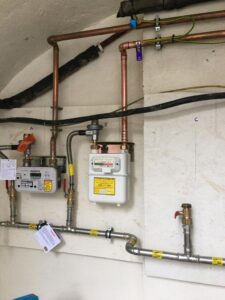
- Check the Gas Supply: Ensure that your gas meter is turned on. If you have a prepaid meter, make sure there is sufficient credit. Test other gas appliances in your home, like a gas cooker, to verify there is a gas supply.
- Reset the Boiler: Sometimes a simple reset is all that is needed. Press and hold the reset button for a few seconds. If the boiler does not ignite, do not keep pressing it, as this may cause internal damage.
E50: Hot Water Temperature Sensor Fault
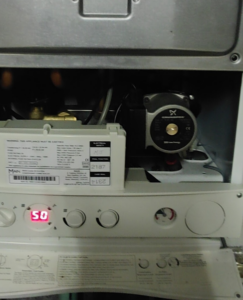
The E50 fault code points specifically to a problem with the Domestic Hot Water (DHW) NTC thermistor. This sensor is responsible for measuring the temperature of the water being heated for your taps and showers.- What this means:
-
- Faulty Thermistor: The sensor itself may have degraded over time and is providing incorrect readings to the boiler’s circuit board.
- Wiring Issues: The wiring connecting the thermistor to the printed circuit board (PCB) may be loose or damaged.
When to Call a Professional
Safety Considerations
While basic checks like topping up water pressure or thawing a condensate pipe can be done safely, you should never remove the boiler casing. Here is when to contact a Response Gas Safe registered engineer:- Internal Component Faults: Errors like the E50 require testing and replacing internal parts like sensors, valves, or the PCB.
- Suspected Gas Leaks: If you smell gas at any point, turn off your gas supply at the meter, open windows, and immediately call an emergency Gas Safe engineer.
- Persistent Issues: If you have repressurised the system but the E119 code keeps returning, there is a deeper issue that needs investigation by an expert.